
Guna Score Confusion
Families often worry because the score looks average or lower than expected, even when the couple otherwise seems emotionally aligned.
Kundli matching is one of the most searched astrology intents, but many pages reduce it to a score alone. Families actually want a deeper reading: compatibility, dosha concerns, emotional patterning, family rhythm, and whether a match feels sustainable. This page is built for that fuller search intent.
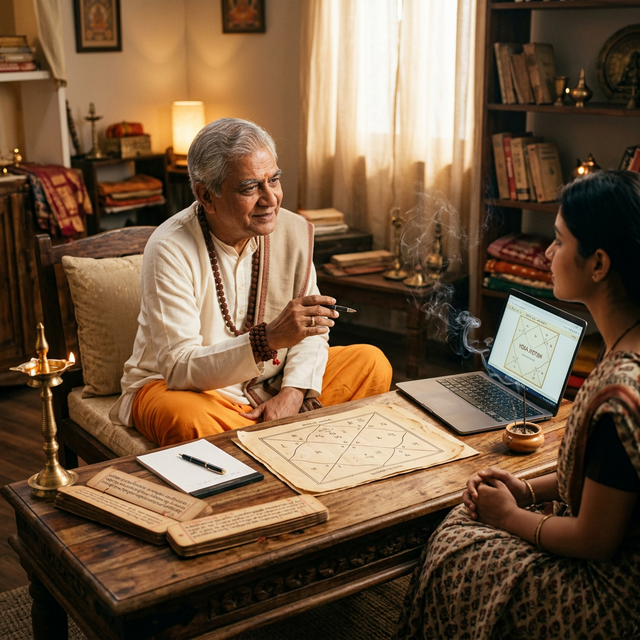
Most matching conversations become more useful when they move past a single number and toward real relationship context.
Families often worry because the score looks average or lower than expected, even when the couple otherwise seems emotionally aligned.
Some people come specifically to understand Manglik questions, what they mean in practice, and whether remedies or broader chart context change the reading.
When two families come from different linguistic or ritual backgrounds, matching is often used to discuss adjustment, household rhythm, and value compatibility.
Later-in-life matches are often less about idealized romance and more about stability, temperament, emotional readiness, and respect.
Sanatani Pandit has helped many families through kundli matching conversations where the real need was clarity, not fear. People often come after hearing incomplete advice about guna scores or doshas. A better consultation explains what is being compared, what matters most, and where families should not overreact to one isolated factor.
We help present compatibility as a fuller reading that includes temperament, family flow, and practical long-term fit instead of reducing the decision to a number alone.
Where Manglik or other concerns arise, the aim is to explain the context clearly rather than increasing fear or confusion inside the family.
The consultation can also include timing discussion, relationship maturity, and whether both people appear ready for the responsibilities of marriage.
Kundli matching is often associated with Ashtakoot or guna milan, but experienced astrologers usually go further by examining the 7th house, Navamsa, Moon compatibility, dosha patterns, and overall relational stability.
This gives one structured compatibility framework, but it is only one layer in the broader reading and should not be treated as the entire truth of the relationship.
Where Manglik or other concerns appear, astrologers may compare both charts carefully to see whether the pattern is amplified, balanced, or less decisive than the family fears.
Long-term compatibility usually depends on emotional maturity, values, communication, and shared responsibility as much as chart technique.
These stories are unique to the kundli matching page and reflect the kind of marriage compatibility conversations people usually bring here.
Both families liked the alliance and the couple themselves felt comfortable, but one average compatibility score had created immediate panic inside the discussion. Instead of seeing the match in a fuller way, everyone became stuck on a number. The consultation helped move the conversation toward temperament, emotional tone, practical compatibility, and whether the broader chart picture actually supported a workable long-term relationship.
The concern began with a single word heard from another source, and within days the entire proposal had become tense. Nobody was clear on what the label meant in context, but fear spread quickly through the family. The astrologer was asked to explain how much weight the concern actually deserved, whether the broader chart picture changed the interpretation, and whether remedies or matching context reduced the intensity of that fear.
This match was not facing outright rejection, but both households were quietly anxious about language, customs, family rhythm, and how two different cultural habits would live under one roof. The question was less about technical rejection and more about adjustment with dignity. Matching became a way to discuss values, emotional flexibility, and how the couple might hold two family cultures together with maturity and mutual respect.
Because this was a second-marriage proposal, the family was not looking for idealized romance or social appearances alone. They wanted to know whether the charts suggested a calmer, more stable bond and whether both individuals seemed emotionally ready for a grounded partnership. The reading was therefore approached with a more mature lens, focusing on steadiness, respect, temperament, and realistic long-term compatibility rather than a superficial match on paper.
Kundli matching is culturally important for many families, but it is not scientifically proven to predict marital success with certainty. It can help families slow down, reflect, and ask better questions, yet trust, consent, communication, and emotional safety remain essential.
A matching score should never override obvious compatibility problems, disrespect, coercion, or emotional instability. Use astrology as a framework for reflection, not as a substitute for real relationship judgment.
Share both birth details and the stage of the discussion, and Sanatani Pandit can help connect you with an astrologer for thoughtful compatibility guidance.